
How to Arrange Furniture in a Small Living Room
Ready to give your tiny apartment a total makeover? Learn how to arrange furniture in a small living room with our favorite DIY-friendly tips.
MOVING & HOME TIPS
2/21/20265 min read
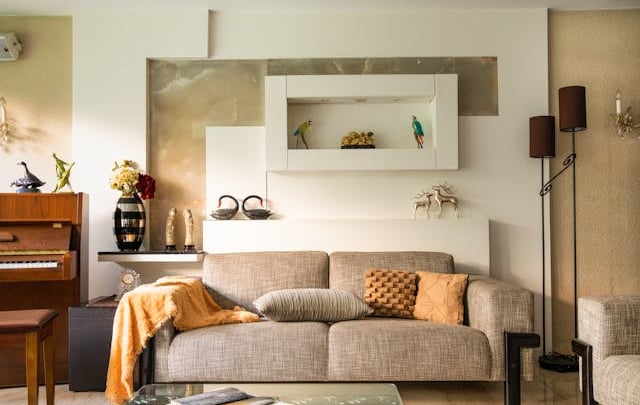
7 Tips to Arrange Furniture in a Small Living Room
You’re standing in your living room, and it feels more like a frustrating game of Tetris than a place to actually kick back. You nudge the armchair two inches to the left, only to realize you’ve blocked the radiator or created a doorway obstacle course that requires Olympic-level agility just to reach the remote. It’s a total headache when your square footage screams "closet" but your lifestyle yells "hosting hub."
Most of us have been there: staring at a space that needs to be a movie theater, a home office, and a spot for Saturday morning coffee all at once. The good news is that square footage doesn’t dictate style or comfort. In fact, some of the most inviting homes are the smallest ones because they force us to get creative with how we move and breathe within our four walls.
The secret to breaking out of that cramped box involves playing with the architecture of the room to trick your brain into seeing wide-open space.
By shifting a few pieces and being intentional with your layout, you can turn a cramped box into a curated sanctuary has the space twice its actual size. Below are seven actionable ways to rethink your setup and make every inch count.
See also: The Complete Guide to Boosting Mobile Home Curb Appeal
1. Pull your furniture away from the walls.
We won't blame you if your first instinct is to push every chair and sofa flush against the wall to "open up" the center of the room. But ironically, this backers by highlighting exactly how small the boundaries are. Try pulling your sofa forward just four to six inches.
This will create a tiny pocket of air behind the furniture that tricks the eye into thinking the room is deeper than it is and your seating area will also stop looking like a mere collection of items clinging to the perimeter for dear life.
2. Choose pieces with exposed legs.
Visual weight is a major player in small-space design. If you have a sofa that sits directly on the floor with a heavy skirt or blocky base, it acts like a giant anchor, stopping the eye and making the floor look smaller. Instead, look for mid-century modern styles or contemporary pieces with slim, tapered legs.
Raised furniture allows you to see the floor extending underneath.
This extra peek of flooring creates a sense of continuity.
It lets light flow through the room more easily, preventing dark, heavy corners.
See also: Transform Your Home into a Profitable Airbnb
3. Maximize your vertical real estate.
When you run out of floor space, the only way to go is up. Most people forget they have eight to ten feet of height to play with. Tall, narrow shelving units or floor-to-ceiling bookcases draw the gaze upward, making the ceiling appear higher.
Use the top shelves for items you don't need daily, like seasonal decor.
Install floating shelves to keep surfaces like coffee tables clear.
Mount your TV on the wall to reclaim the surface area of a bulky media console.
4. Invest in multi-functional workhorses.
In a small living room, every piece of furniture needs to earn its keep, ideally by doing two or three jobs at once. If an item only serves one purpose, it might be taking up more than its fair share of the room.
Storage Ottomans: These act as a footrest, extra seating for guests, and a hidden bin for blankets or board games.
Lift-Top Coffee Tables: These look like standard tables but can transition into a desk or dining surface when you’re working from the couch.
Nesting Tables: These are perfect for entertaining because they stack away into a tiny footprint when the party is over.
See also: Colorado Homeowners, Try These 7 Simple Home Improvement Ideas
5. Use a large area rug to anchor the space.
Ordered a small rug online to match a small room? Truth be told, it will only chop up the floor and make the room look disjointed.
Exchange it for a larger rug that extends under the front legs of all your seating pieces. Not only will it create a unified zone, it also demarcates the living area within the room, so the layout becomes purposeful and expansive rather than scattered.
6. Incorporate glass or acrylic surfaces.
If you need a coffee table or a side desk but don't want to lose the sense of openness, go "invisible", like literally.
Glass or clear acrylic furniture provides the surface area you need and since you can see right through these pieces, the brain doesn't register them as clutter and the sightlines are clear from one side of the room to the other.
7. Position mirrors opposite your windows.
Mirrors are the oldest trick in the book for a reason: they work. Placing a large mirror directly across from a window reflects the natural light and the view from outside, essentially acting like a second window. If a massive, floor-to-ceiling mirror isn’t your style, you hang a collection of smaller framed mirrors to bounce light into those stubbon, dark corners.
Usually, in a small space, your eyes hit a dead end the moment they land on a solid wall, which reinforces that boxed-in atmosphere. When you place a mirror directly across from a window, it breaks the monotony of your four walls and introduces a virtual opening that makes the air seem much easier to breathe.
In other words, without mirrors, a small room feels two-dimensional and restrictive. With them, you’re creating a third-dimensional illusion of walls dropping away.
See also: Lofted Cabin Shed Living: A Minimalist’s Dream Home
Frequently Asked Questions
Can I use a sectional sofa in a small living room?
Absolutely. While it sounds counterintuitive, one large sectional can actually take up less visual space than a sofa and two armchairs. Consider tucking a sectional into a corner. That way, you can utilize a dead zone to provide plenty of seating and not crowding the middle of the room with multiple legs and gaps.
What is the best color palette for making a room feel bigger?
Soft, light neutrals like off-white, light gray, or pale beige are classic choices because they reflect light. However, don't be afraid of color capping or using a darker hue on a single wall. Deep tones lend unexpected depth and make the walls give the impression that they are receding.
How do I arrange furniture in a long, narrow living room?
Avoid the "bowling alley" effect by creating distinct zones. Use a rug to define the seating area and a small console or desk at the other end. Placing furniture at a slight angle or using round coffee tables can also help break up the long, harsh lines.
Is it better to have few large pieces or many small pieces?
Fewer, larger pieces are generally better. A room filled with many small items can look cluttered and fussy. A single, well-scaled sofa paired with a statement lamp creates a much cleaner, more sophisticated look than several tiny chairs crammed together.
How can I add storage without adding more furniture?
Look for hidden opportunities. Use decorative baskets under coffee tables or on open shelves to hide cords and remotes. You can also swap a standard end table for a small vintage trunk or a cabinet with doors to keep everyday essentials out of sight.
Should I avoid dark furniture in a small space?
Not necessarily. While light furniture is airier, dark pieces can provide a beautiful anchor. The key is balance. If you have a dark navy sofa, pair it with a light rug and glass tables to ensure the room doesn't feel too heavy or closed in.
Where should I place my TV in a tiny layout?
Wall-mounting is the gold standard for small rooms. It frees up floor space and allows you to position the TV at the perfect eye level. If you can't mount it, choose a slim, open-frame console that doesn't block the view of the floor or walls.
See also: The 10-Step Guide to Picking Paint Colors for Small Living Spaces
Explore
Welcome to Stay Curious, your home for free online calculators and blogs that make you stop and think. Here, questions never get old and answers are always a little unexpected.
We dig into the weird and wonderful, challenge the obvious, and cover topics that make you think, "Why didn't I know this sooner?" From quirky facts to deep dives into everyday mysteries, we are all about satisfying that itch for knowledge you didn't know you had.
So go ahead, stay curious. We promise it'll be worth your while. Or, you know, not. ;)
Contribute
Learn
ask.staycurious@gmail.com
© 2025. All rights reserved.
We welcome guest posts on business, tech, travel, finance, lifestyle, career, relocation, and home improvement. Submissions must be original, unpublished (online), at least 800 words, and written in English.
Ready to contribute? Contact us with your ideas!