
How Easter Island Statues Were Made and Moved
Visiting Easter Island soon? Read how the famous moai statues were made, moved, and placed across the island by the ancient Rapa Nui.
TRAVEL
3/4/20269 min read
The Giants That Walked: Unpacking the Mystery of Easter Island
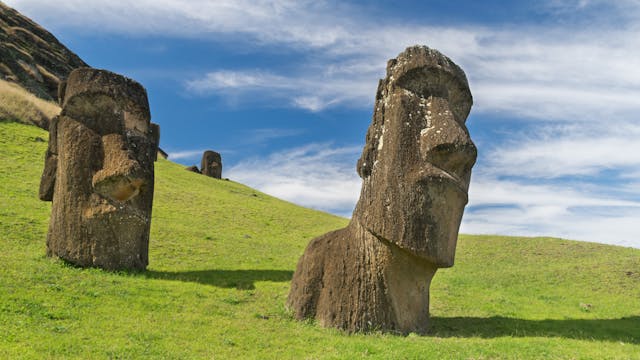
The massive stone faces of Easter Island have puzzled travelers and scientists for centuries. Known as Moai, these monolithic figures stand as silent sentinels across Easter Island—or Rapa Nui, as it’s known to the people who live there—staring inland with an expression that seems to say they know something we don’t.
For decades, the big question wasn't just why they were made, but how. How did a society living on a remote speck of land in the middle of the Pacific, without wheels, cranes, or even large pack animals, move statues that weigh as much as a Boeing 737 across miles of rugged volcanic terrain?
The leading theory was pretty grim for the longest time. It suggested the islanders cut down every single tree to make wooden rollers, eventually destroying their own ecosystem in an obsessive race to build more monuments. But lately, thanks to some clever archaeology and a bit of physics, a much cooler story has emerged.
It turns out the Rapa Nui didn't just move their statues. They made them walk.
Bear in mind that that for the people of Rapa Nui, the moai weren’t mere decorations. They represented ancestors, leaders, or important individuals and were believed to embody spiritual power, what many scholars call mana. Their placement around the island, facing inland, suggests the statues were meant to watch over the villages and bless the communities.
The Scale Of What They Built
Before we get into tools and techniques, let's first understand the size of these statues.
The average moai stands about 13 feet tall and weighs around 13 to 14 tons. That’s roughly the weight of two large elephants. Some are smaller, closer to 10 feet. Others are enormous.
The largest moai ever successfully transported and erected is about 33 feet tall and weighs an estimated 80 to 86 tons. And in the quarry at Rano Raraku, there’s an unfinished giant that would have stood nearly 70 feet tall and weighed well over 150 tons if completed.
Let that sink in. A society working without metal tools or wheeled vehicles carved and attempted to move stones heavier than a blue whale.
For anyone visiting today, standing next to one of these statues is the fastest way to grasp the scale. Photos flatten them. In person, they feel overwhelming.
See also: 10 Beautiful Italian Poems for Those Studying the Language
Carving the Moai
Now here’s the part that really blows people’s minds: the Rapa Nui didn't use any metal chisels or power tools to carve these incredible statues. Instead, they used handheld stone chisels called toki, made from a much harder type of basalt.
Most moai were created at Rano Raraku, an extinct volcano on the island’s slopes. This place was the island’s main "statue factory." Almost all of the 900+ statues on the island came from this one spot because the rock there, a compressed volcanic ash called tuff, is relatively soft and easy to carve.
Workers would start by roughly outlining the shape right in the face of the rock. Then they gradually chipped away:
Smoothing the features.
Hollowing out details like eyes and ears.
Cutting into the stone carefully until a full statue emerged, still attached to the rock behind it.
Picture a team of about 15 master carvers working on a single statue. They would carve the Moai on its back, right out of the bedrock. They’d finish the face, the long ears, and the delicate hands first, leaving a narrow "keel" of stone along the spine to keep it attached to the mountain.
When the front was done, they’d chip away that last bit of stone and slide the giant down the slope of the volcano into a hole. This let the statue stand upright so the carvers could finish the back. Evidence shows that most statues were carved lying on their backs (known as a supine position) and worked from top to bottom.
Researchers have also found that this huge operation wasn’t run by a single master builder. Instead, there were many workshops spread around the quarry, each with its own style and way of doing things.
Once a statue was finished (or sometimes partway finished), crews would detach it from the bedrock and prepare it for the next big challenge: getting it to its destination. If you visit the quarry today, you’ll see hundreds of statues still there in various stages of completion, some still half-merged with the cliffside, looking like they’re waiting for their turn to join the party.
See also: 15 Must-Need Travel Accessories to Pack for Every Trip
Getting the Moai to Their Sites
This is where things get really interesting and a bit controversial.
When we talk about Maoi, we’re talking about figures that average 13 feet tall and weigh around 14 tons. The biggest one ever moved was a staggering 80 tons. For years, scientists like Thor Heyerdahl and Jared Diamond thought the islanders must have laid the statues flat on wooden sledges or rollers. This theory fit the ecological collapse narrative that the islanders used so much wood for transport that they caused a massive deforestation.
But there was a problem. The oral traditions of the Rapa Nui people didn't mention rollers or sledges. Plus, the island had few trees at the time, and dragging multi-ton statues across varied terrain seemed impractical. When early explorers asked how the statues got there, the locals always gave the same simple answer: They walked.
For a long time, Western researchers figured this was just a myth or a metaphor, and thus kept testing and exploring, until in 2012, anthropologists Carl Lipo and Terry Hunt decided to take that literal "walking" idea seriously.
The Walking Statue Idea
Lipo and Hunt noticed something interesting about the statues found abandoned along the ancient roads. They weren't just random statues; they had specific features that the finished statues on the platforms didn't have.
These road Moai had wider, D-shaped bases and a center of gravity that tilted slightly forward. If you try to stand one of these up, it wants to fall on its face. To a casual observer, that sounds like a design flaw. To an engineer, it’s a feature.
Teams of people would use long ropes tied around the statue. By pulling alternately on either side, the statue would tilt forward a little, pivot on its base, then rock forward again. Do that over and over, and voilà, the statue literally walks forward in a zigzag motion.
This idea is even more convincing because scientists have tested it in real life. With a replica moai weighing more than four tons and using using three heavy ropes, one tied to each side of the head and one at the back to act as a brake, a team of about 18 people could rock the statue from side to side. Because of that rounded base and the forward tilt, every time the statue rocked, it would pivot and take a little "step" forward and walked 100 meters in just 40 minutes.
And physics backs it up: the statue’s forward tilt creates a shifting center of gravity that makes walking forward surprisingly efficient once you get it rocking.
This method doesn’t mean only huge crowds of workers could do it either. According to another recent study, as few as 15 to 60 people could move a statue in this way, depending on its size, which is a big shift from the older idea that hundreds were needed.
Walking-friendly roads
This theory also explains why the ancient roads on Easter Island look the way they do. They aren't flat; they’re actually concave, like a shallow U-shape.
If you were trying to roll a statue on logs, a curved road would be a nightmare: the logs would constantly get stuck or veer off. But if you’re "walking" a heavy, rocking object, a concave road helps keep it centered. It’s like a natural guidance system.
Archaeologists also found that the statues abandoned on the roads weren't just left there because people gave up. Most of them are broken in ways that suggest they fell while being moved. If a statue was being moved upright and it tipped over, the neck—the thinnest part—would snap. That’s exactly what we see in the failures left along the trails.
Setting Them Upright On Platforms
Once the moai reached a village or ceremonial site, they were placed on ahu platforms. Getting a massive statue from lying on the ground to standing tall wasn’t a small job.
While we don’t have a complete step-by-step picture, researchers think they used ramps, levers, and teamwork. Workers would raise one end slowly, using packed earth and simple wooden tools until the statue stood upright on its base.
Some moai were topped with pukao, red scoria stones carved into shapes like hats or topknots. These were quarried at a different site and rolled or carried separately to the ahu before being lifted into place.
See also: 5 Best Summer Destinations in Europe
More Than Just a Pretty Face
We often call them the "Easter Island Heads," but that’s actually a bit of a misnomer. Every single Moai is a full-bodied statue with a torso, arms, and hands. The reason we think of them as just heads is that over hundreds of years, the wind-blown soil of the island buried many of them up to their necks.
When archaeologists started digging, they found the bodies were covered in intricate carvings—petroglyphs representing the "birdman" cult and other important symbols.
And then there are the eyes. When a Moai finally reached its ceremonial platform, the islanders would carve out the eye sockets and insert "whites" made of white coral and "pupils" made of black obsidian or red scoria. This was the final step that "awakened" the statue. In the Rapa Nui language, the statues were called aringa ora, which means "living faces." They weren't just decorations; they were the living presence of ancestors, watching over the village and protecting the people with their mana, or spiritual power.
The Hats That Topped It Off
If the walking statues weren't impressive enough, some of them also wear massive red stone hats called pukao. These aren't actually hats, though; they’re thought to represent the top-knots or hair bundles that were popular among high-ranking men at the time.
What’s wild is that these hats come from a completely different quarry called Puna Pau, where the rock is a distinct red volcanic stone. Moving a 10-ton statue is one thing; lifting a 2-ton red stone cylinder onto its head once it’s standing is another level of difficulty.
Recent research suggests they used a technique called "parbuckling." They likely built long ramps made of stone and soil, then used ropes to roll the cylinders up the ramp and onto the statue’s head. It’s yet another example of how the Rapa Nui used simple physics to solve massive problems.
See also: 10 Ways to Raise Capital for a Business
Why They Stopped Though
By the time Europeans arrived in the 1700s, the statue-building era was mostly over. The island was largely treeless, and many of the statues had been toppled—likely due to internal conflicts between different clans.
For a long time, the world looked at Easter Island as a cautionary tale of "ecocide," where people destroyed their environment for the sake of their monuments. But the walking Moai discovery changes that story. If they didn't need thousands of logs to move the statues, then the deforestation might have been caused by other factors, like the arrival of Polynesian rats that ate all the palm seeds, or gradual climate shifts.
Instead of a story of self-destruction, the Moai represent one of the most incredible engineering feats in human history. It’s a story of a small, isolated community that used its deep knowledge of stone, rope, and balance to create something that would literally stand the test of time.
What We Still Don’t Fully Know
Even with all this research, we still don’t have every detail nailed down.
Exactly how the largest moai were moved remains debated.
We’re still discovering new statues in unexpected places.
And there are plenty of myths and oral traditions that talk about moai “walking” or moving through spiritual or supernatural means, stories that may have roots in how people experienced these events long ago.
But the recent experimental and physics-based evidence gives us a much clearer picture than we ever had before.
Wrapping Up
Understanding how the moai were made and moved isn’t just solving a cool archaeology puzzle. It tells us something important about the people who lived on Rapa Nui:
They were skilled builders with deep knowledge of stonework.
They understood balance, movement, and physics in ways that allowed them to do stuff we often think of as “modern.”
Their society was highly organized, capable of sustaining long-term, collaborative efforts involving hundreds of workers over decades.
And they left us a legacy that continues to inspire amazement around the world.
The moai aren’t just giant rocks. They’re a testament to human creativity, persistence, and the power of working together, and for that reason alone, they’ll keep drawing people’s curiosity for generations.
If you ever get the chance to see them in person, it’s worth remembering all the thought, effort, and ingenuity that went into every single one of those statues. They didn’t get to be one of the great wonders of the ancient world by accident, and now we’re finally beginning to understand just how they did it.
See also: The Best Screen-Free Activities for 4-Year-Olds: No Tech Required
Explore
Welcome to Stay Curious, your home for free online calculators and blogs that make you stop and think. Here, questions never get old and answers are always a little unexpected.
We dig into the weird and wonderful, challenge the obvious, and cover topics that make you think, "Why didn't I know this sooner?" From quirky facts to deep dives into everyday mysteries, we are all about satisfying that itch for knowledge you didn't know you had.
So go ahead, stay curious. We promise it'll be worth your while. Or, you know, not. ;)
Contribute
Learn
ask.staycurious@gmail.com
© 2025. All rights reserved.
We welcome guest posts on business, tech, travel, finance, lifestyle, career, relocation, and home improvement. Submissions must be original, unpublished (online), at least 800 words, and written in English.
Ready to contribute? Contact us with your ideas!